Ricerca

A rigorous study, without the drag

AI compresses the busywork. Our R&D experts supply the rigor. Six phases, and at every one you know two things: what we need from you, and what you get back. For most studies that runs in weeks rather than months - with the caveat that the pace is set by how fast your data lands, not by how fast we type.

We typically reply within one business day.

  1. Scope and connect. What we need from you: Entity, tax years, and who owns the technical work. What you get: A scoped engagement and a connection plan.
  2. Intake and data pull. What we need from you: Access to payroll, the ledger and ticketing. What you get: Your own data pulled, reconciled and mapped.
  3. Identify and interview. What we need from you: Short interviews with each technical lead. What you get: A business component list with named owners.
  4. Narratives and QRE computation. What we need from you: Confirmation of the component list. What you get: Draft narratives and a QRE workpaper.
  5. Adversarial AI review and expert finalization. What we need from you: Answers to the questions the review raises. What you get: A finalized position signed off by our R&D experts.
  6. Deliver and file support. What we need from you: Your preparer and their filing dates. What you get: The study, the workpapers and the 6765 line map.
  7. Pace is set by how fast your data lands, not by a calendar we hand you.
Illustrative. These are the phases every study runs through. No fixed duration is implied and the elapsed time is not a promise.
Six phases

From kickoff to audit-ready, one screen at a time

Most of the lift happens behind the scenes. Here is the screen each phase actually happens on, and what you hold at the end of it.

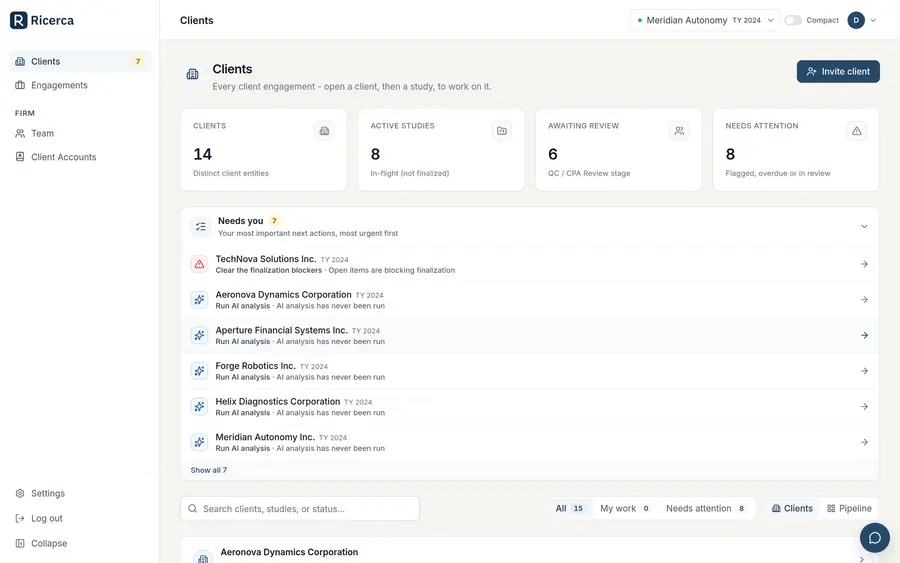
  1. An engagement board showing every client study, with a ranked list of the next actions across all of them above it.
    Every engagement on one board, with the next actions ranked above it. Synthetic studies.
    PHASE 01

    Scope & kickoff

    We learn what your teams build, identify the business components in play, and agree on scope, years, and plan. No long questionnaire to start - a conversation, then a written scope.

    What you receive

    • A written scope: components, years, and what the study covers
    • An engagement letter you e-sign in the portal before work begins
    • A named point of contact and a request list you can see shrink
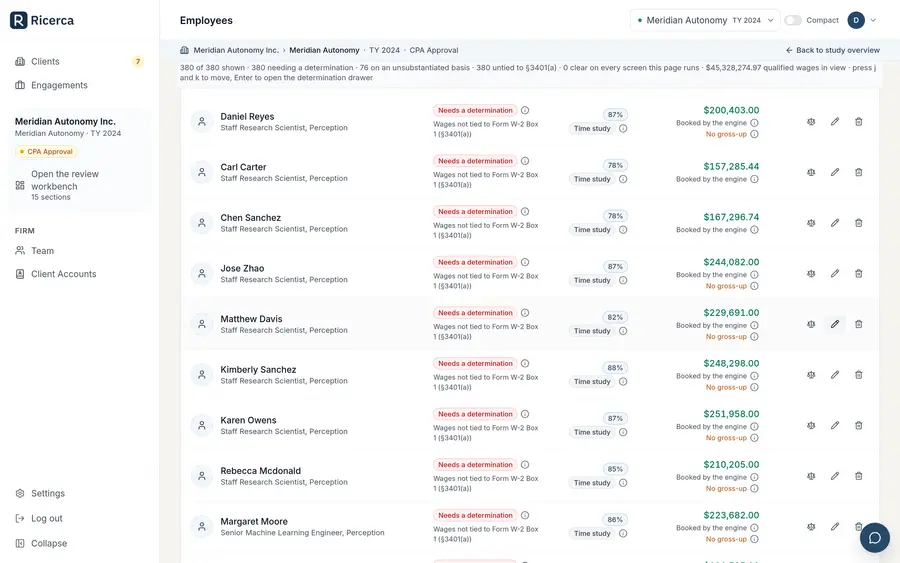
  2. A wage allocation grid holding a full roster: each employee with a qualified percentage, the basis recorded for it, and the qualified wage figure.
    Your payroll register, landed and reconciled: every row carries its own basis and its own open determination. Synthetic study data.
    PHASE 02

    Connect & gather

    Connect payroll, your general ledger, and engineering systems (source control, issue tracking), or upload exports. The platform parses and organizes the evidence as it lands.

    What you receive

    • An organized evidence set, each figure traceable to payroll, GL, or invoice
    • A live outstanding-items list in the portal instead of email ping-pong
    • Early flags where the data will not support what someone hoped to claim
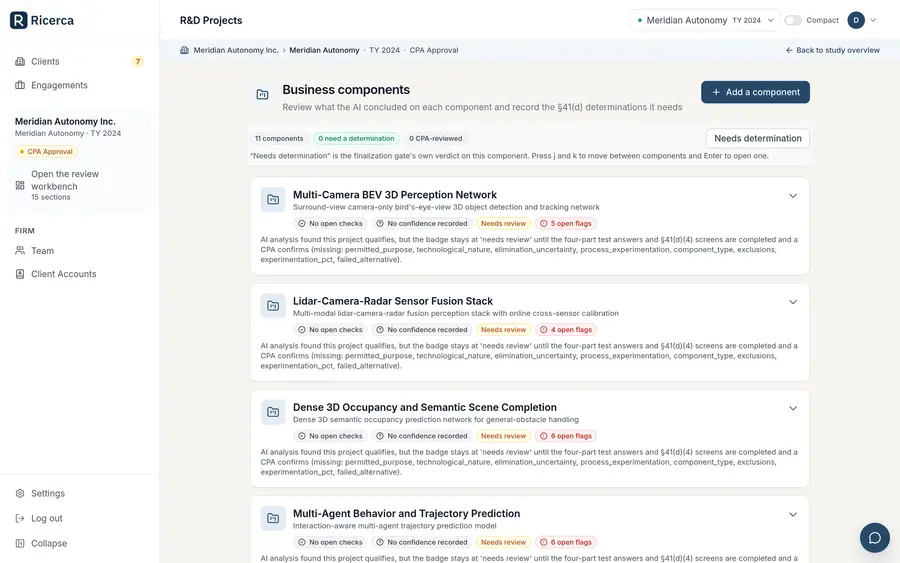
  3. Business components listed with what the AI concluded on each, which four-part-test answers are still missing, and the open flags a reviewer has to clear.
    Each component with what the AI concluded, what is still missing, and the flags a reviewer has to clear. Synthetic study data.
    PHASE 03

    Identify qualifying activities

    Candidate activities are surfaced, mapped to the IRC §41 four-part test per business component, and drafted into technical narratives. Your engineers confirm and correct the facts.

    What you receive

    • Business components mapped to all four parts of the test, one by one
    • Draft technical narratives written for a reader who was not in the room
    • Documented §41(d)(4) exclusion screens - including the work we are excluding, and why
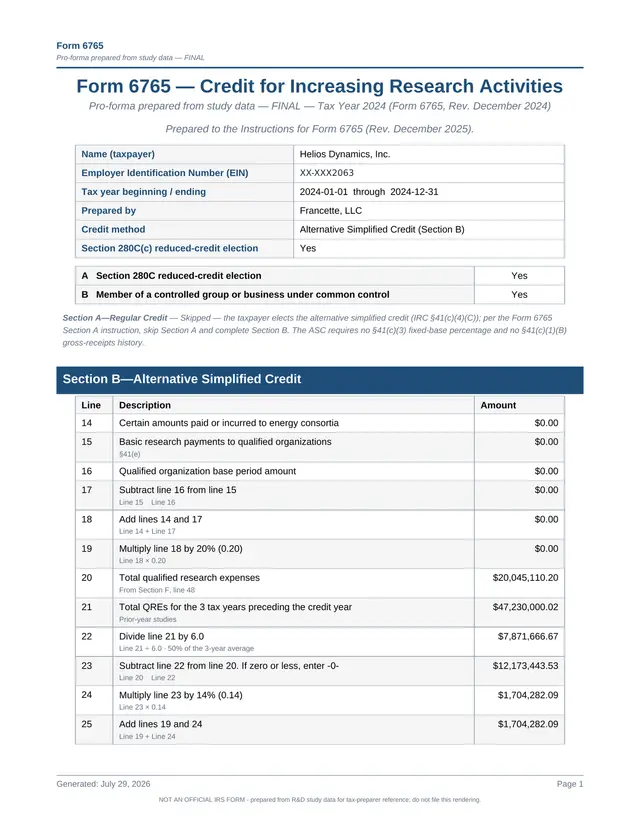
  4. Page one of a generated pro-forma Form 6765: the taxpayer block, the Section 280C election, and the Section B alternative simplified credit computed line by line.
    Page one of a real generated pro-forma Form 6765, computed line by line from the study. Synthetic taxpayer and figures; not an official IRS form.
    PHASE 04

    Compute QREs & the credit

    Wages, supplies, contract research, and cloud or computer rental are totaled, then the Regular and Alternative Simplified methods are compared - with your §174A domestic expensing position mapped alongside.

    What you receive

    • QRE workpapers by category, sourced line by line
    • Both credit methods computed side by side, with the stronger supportable result identified
    • State credits from the same base, and the §41(h) payroll-offset path where a qualified small business elects it
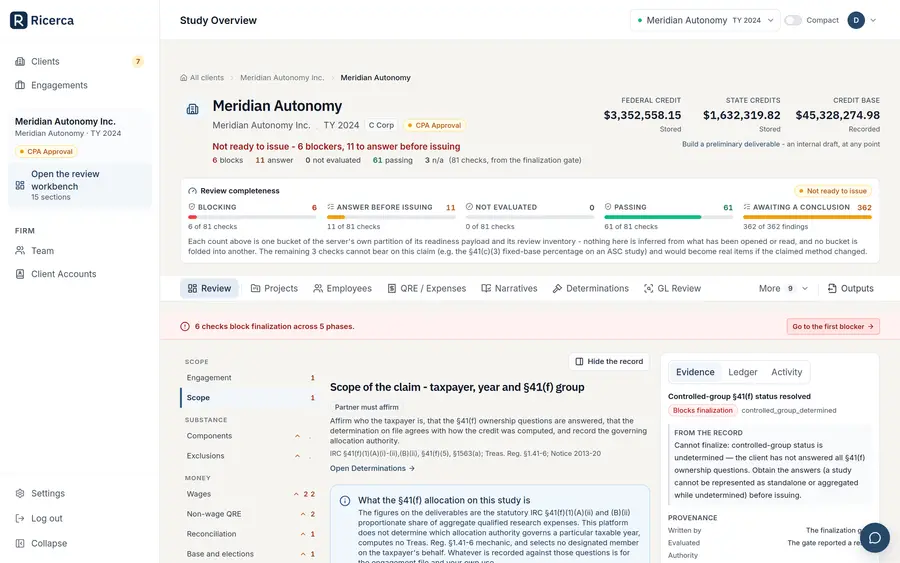
  5. The three-pane review workbench: headline credit figures, the readiness partition across 81 checks, the phase rail, and the evidence rail holding the record behind a blocking check.
    The reviewer works a partition of checks, not a vibe: what blocks issuing, what has to be answered, what passes. Synthetic study data.
    PHASE 05

    Expert review & finalize

    An independent AI examiner red-teams the study and a second model family re-checks the statutory tests, then R&D experts review qualification decisions, amounts, and narratives and finalize the study. People decide; AI never does.

    What you receive

    • A study finalized by experienced R&D experts, not auto-issued by software
    • Every qualification call explained, with the evidence it rests on attached
    • An abstention where substantiation is thin, instead of a guess dressed as a conclusion
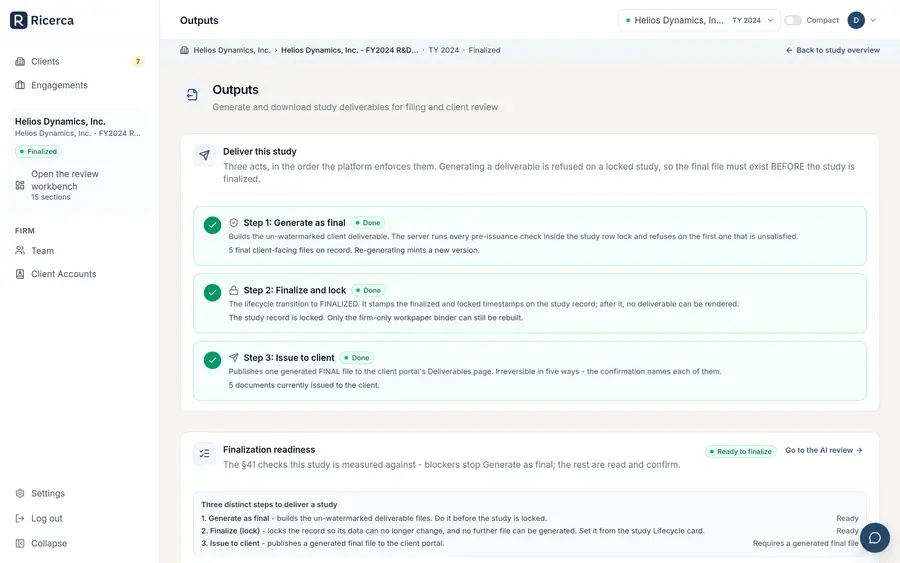
  6. The three delivery steps on a finalized study: generate as final, finalize and lock, issue to the client - each marked done.
    Generate as final, finalize and lock, issue to the client. The order is enforced by the server. Synthetic study data.
    PHASE 06

    Deliver & defend

    You receive the study, filing-ready forms, and an organized audit file - built to answer the questions an examiner actually asks. Every study is backed by Audit Protection.

    What you receive

    • The study report and technical narratives, per business component
    • Form 6765 (Dec. 2024 revision, Sections A-G), Form 8974 where the payroll election applies, and a pro-forma Form 3800
    • An audit file organized the way an examination proceeds - plus Audit Protection

The machinery behind these phases - the exclusion screens, both credit methods, the adversarial review - is described on the platform page. What each phase is building toward is described in documentation & substantiation.

The ask, in one place

What we need from you

Every request a study makes of your team, phase by phase, with the form we can take it in and the person it usually comes from. Nothing here is a surprise later.

The client-side checklist for a study
Phase What we need In what form Usually from
1. ScopeA short conversation about what you build and where the hard problems areA call, not a questionnaireYour technical lead
1. ScopeEntity and ownership structure, so §41(f) controlled-group aggregation is settled earlyAn org chart or a short written summaryFinance or counsel
1. ScopePrior R&D claims, base-period history, and which years are still openPrior returns or workpapersYour tax preparer
1. ScopeAny grant, SBIR, or customer-funded work, so funded research is screened at scopeThe agreements themselvesFinance or counsel
2. GatherPayroll register and roster for the yearA read-only connection, or an exportPayroll administrator
2. GatherGeneral ledger detailA read-only connection, or an exportController
2. GatherContract-research agreements and statements of workUploaded to the portalFinance or counsel
2. GatherSupply, cloud, and computer-rental invoicesUploaded, or an AP exportAccounts payable
2. GatherEngineering systems, if you want them usedRead-only access, metadata only, never source codeEngineering lead
3. IdentifyShort, focused sessions with the engineers who did the workOne session per technical leadEach technical lead
3. IdentifyThe honest version of what was uncertain, and which alternatives you evaluatedIn the session, or typed into the portalEach technical lead
3. IdentifyA sanity check on the component list: what shipped, what was abandoned, what is still runningIn the portalYour technical lead
4. ComputeConfirmation of role and time allocations for the people in the claimIn the portal, on the allocation gridEach team’s manager
4. ComputeBase-period figures for prior years where the Regular Credit is in playPrior returns or workpapersYour tax preparer
4. ComputeA decision on the §280C(c) reduced-credit electionA written confirmation, with our modeling in front of youFinance, with your preparer
5. ReviewAnswers to the open questions review raises - usually a handful, always specificIn the portalWhoever owns the fact
5. ReviewYour confirmation of the technical facts as written, before anything is issuedIn the portalYour technical lead
6. DeliverThe package in your preparer’s handsWe can send it to them directlyYou, or us on your say-so
Illustrative. Scope varies: a single-component study asks for less than this, and a controlled group with open prior years asks for more.

What we do not need

Your source code

Engineering connectors read metadata only - issues, commits, and their timestamps. The code itself never leaves your systems.

Day-long interviews

The technical sessions are short and focused. They cannot be skipped, because the facts have to come from the people who did the work.

A new time-tracking system

The study is built from the records you already keep. Where an allocation rests on an estimate, the basis for it is recorded as an estimate.

A tidy answer on day one

Where the facts are uncertain we say so in writing, including when the answer is that a component does not qualify.

What the work produces

From a ticket your engineers already wrote, to a narrative an examiner can read

The raw record is rarely wrong. It is just written for the person who wrote it. A study has to add the uncertainty, the alternatives, the test, and where the evidence lives - without inventing any of it.

Before: the record as it exists

Issue tracker export

Illustrative - synthetic data

JIRA-2231 Gripper compliance controller saturates at 80% load

Component: Gripper control / Sprint 14 / Status: Done

try PID gains + feedforward. test rig thermal drift is eating our margin - controller saturates around 80% of rated load and we lose grip force. retuned Kp/Ki, no good above 60%. next: feedforward term off the load cell, then re-run the thermal soak.

Nothing in this ticket is wrong. It simply does not say what was uncertain, what else was considered, or how the answer was tested - which is what §41 asks.

1 of 41 issues on this component

After: the narrative in the study

Technical narrative - business component 3 of 7

Illustrative - synthetic data

Business component. Gripper compliance controller, a component of the company’s robotic handling product (Northwind Robotics, tax year 2025).

Permitted purpose. The project was undertaken to improve the performance and reliability of that component. IRC §41(d)(1)(B)(ii).

Technological uncertainty. At the outset the team did not know whether grip force could be held above 80 percent of rated load, or by what design: the existing control loop saturated near that point, and thermal drift in the test rig made results difficult to reproduce. Both capability and method of design were uncertain. Treas. Reg. §1.41-4(a)(3).

Process of experimentation. The team evaluated two alternatives - retuning the existing PID gains, and adding a feedforward term derived from the load-cell signal - and tested each against a thermal-soak protocol on the instrumented rig. The retuned gains failed above 60 percent of rated load; the feedforward design was carried forward and re-tested.

Evidence on file. Issue JIRA-2231 and its linked commits, the thermal-soak rig logs for the test dates, and the time records of the two engineers assigned to the component.

Page 14 of 62

Both sheets are synthetic: Northwind Robotics is not a real company and no real engagement is shown. The point is the distance between the two, and that nothing in the right-hand sheet is added that the left-hand record and a short conversation with the engineer cannot support.

Human-in-the-loop

What AI does - and what stays human

This is the core difference from automation-only tools: AI augments, people decide.

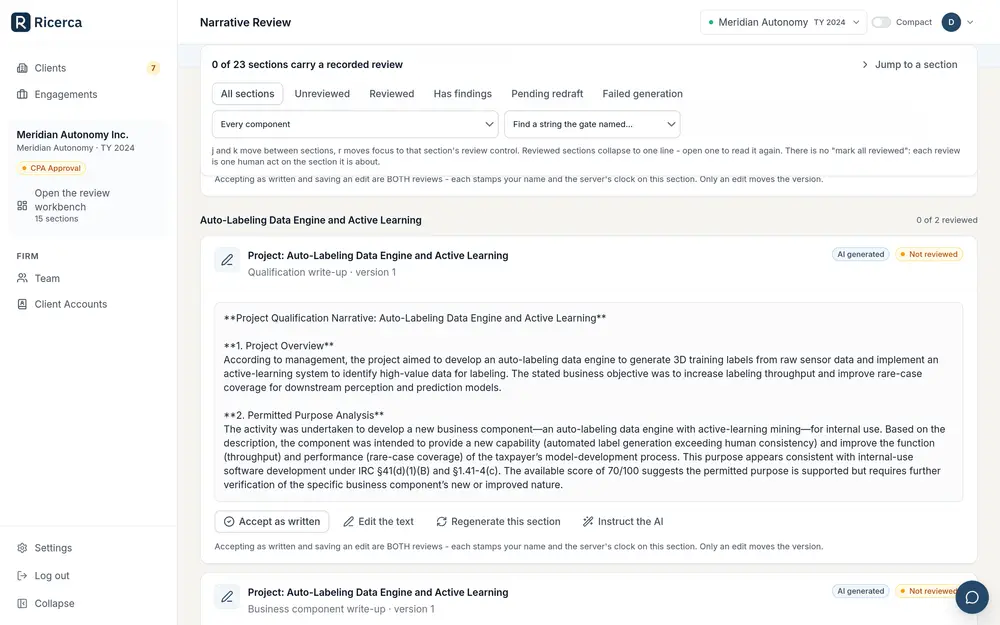
An AI-drafted qualification write-up with the four review controls beneath it: accept as written, edit the text, regenerate this section, instruct the AI.
An AI first draft, and the four acts a human can take on it: accept as written, edit, regenerate, or instruct the model. Accepting is a review and it is stamped as one. Synthetic study data.

AI accelerates

  • Accelerate intake and document parsing
  • Surface candidate qualifying activities
  • Draft technical narratives for review
  • Organize evidence and compute QREs
  • Prepare Form 6765 support

People decide

  • Decide what qualifies and what doesn’t
  • Confirm the technical facts with your team
  • Set final QRE and credit figures
  • Review and finalize the study (R&D experts)
  • Stand behind the work on examination

Weeks, not months - and here is what moves that.

We won’t quote you a day count before we have seen your data. What we will do is tell you which of these four things is holding the study up, at any point you ask.

The dates that actually bind

Some choices exist only on a timely filed original return, including extensions. The §280C(c) reduced-credit election is one. The §41(h) payroll-tax election for a qualified small business is another - it is not available on an amended return.

That is the real reason to start before the return goes out: not urgency theater, just options that close.

How fast the data lands

A payroll export and a GL detail file on day one moves faster than a quarter of follow-ups. This is the single biggest variable, and it is mostly in your control.

How many components are in scope

Substantiation is built per business component. Eight components is not eight times the work of one, but it is not the same work either.

Engineer availability

The technical sessions are short, but they cannot be skipped - the facts have to come from the people who did the work.

Whether prior years are in play

Open years, base-period reconstruction, and amended-return work add scope. Worth it often, but it changes the shape of the engagement.

Ready to skip ahead? Answer three questions and our R&D experts come back with a scoped range.

An audit-ready study you can hand to your preparer

One package, three readers: your leadership, your tax preparer, and - if it ever comes to it - an examiner.

Technical narratives

Per business component, mapped to the four-part test and tied to the engineers who did the work.

QRE workpapers

Wages, supplies, contract research, and cloud or compute - every figure sourced.

Form 6765 support

The Dec. 2024 revision, including the Section G business-component detail.

Audit-ready file

Contemporaneous evidence, exclusion screens, and the analyses examiners ask for first.

Every deliverable traces back to the same substantiated base - the one that also produces your state credits and your §174A expensing position.

Audit Protection included

We stand behind your R&D claim

Every Ricerca study includes Audit Protection. If the IRS examines the R&D tax credit claim from your study, we prepare the response, provide the examiner with the documentation they request, and defend the study’s technical position alongside your tax preparer - under the terms of your engagement agreement.

Representation before the IRS, where it is needed, is performed by credentialed practitioners.

Focused on your R&D claim

Audit Protection covers the R&D study and the related federal R&D tax credits only - not other parts of your return, other tax years, other credits or deductions, payroll taxes, state or local taxes, penalties, or interest.

Based on accurate information

Protection applies as long as the information you give us for the study is accurate and complete. If it isn’t, Audit Protection does not apply and we will not prepare or defend a response to the resulting issue.

FAQ

How a study works - questions

How long does a study take?
For most studies, weeks rather than months - but the honest answer is that the pace is set by how quickly payroll and general-ledger data arrives, how many business components are in scope, and how quickly your engineers can sit for short technical sessions. We give you a realistic window at scoping and tell you immediately if something changes it.
How much of our team’s time does this take?
Far less than a traditional study. AI handles intake and drafting; your engineers mostly review and confirm. We schedule short, focused sessions rather than long interviews, and the portal shows exactly what is outstanding so nothing sits in someone’s inbox.
Who finalizes the study?
Experienced R&D experts review the qualification decisions, the QRE and credit figures, and the narratives, and finalize the study before it is issued. AI assists but never makes the final call - and where reviewers disagree or substantiation is thin, the platform abstains and routes the question to people.
What is Audit Protection - and what does it cover?
Every Ricerca study includes Audit Protection. If the IRS examines the R&D tax credit claim from your study, we prepare the examination response, assemble the documentation the examiner requests, and provide the technical defense of the study, working alongside your tax preparer; representation before the IRS, where it is needed, is performed by credentialed practitioners. It is limited to the R&D study and the related federal R&D tax credits - not other parts of your return - and it depends on the accuracy of the information you provide. See Audit Protection for the full terms.
Are there deadlines that affect when we should start?
Yes, and they are worth planning around. Some choices are only available on a timely filed original return (including extensions) - among them the §280C(c) reduced-credit election and the §41(h) qualified-small-business payroll-tax election, which cannot be made on an amended return. Starting before the return goes out keeps those options open. See calculation methods and the payroll tax offset for the mechanics.
Can you work from our existing systems?
Yes. We can pull from payroll, your general ledger, and engineering tools, or work from documents you upload - whatever is least disruptive. Accounting and payroll connections are read-only, and engineering connectors collect metadata only, never your source code.
What about grant-funded or customer-funded projects?
They are screened at scoping, not discovered at review. Research is excluded to the extent it is funded by another person - the analysis turns on who bears the financial risk and who retains substantial rights under the agreement. Fixed-price and time-and-materials contracts often land differently, so we read the actual agreements rather than assume.
Do you handle prior years and §174A?
Yes. We can look at open tax years - refund claims are generally limited to three years from filing or two years from payment, whichever is later, and §41 refund claims carry their own information requirements, so check current IRS guidance for your facts - and we map your §174A domestic expensing position alongside the credit.

Next: what runs underneath these phases, or, if the credit itself is new to you, the §41 guide.

Ready to start?

Tell us about your R&D. We’ll scope a study, accelerate the busywork, and have our R&D experts finalize it - then hand you an audit-ready file backed by Audit Protection. Pricing is tailored to your study.

[email protected] We typically reply within one business day.
Get your free credit estimate

We typically reply within one business day.