
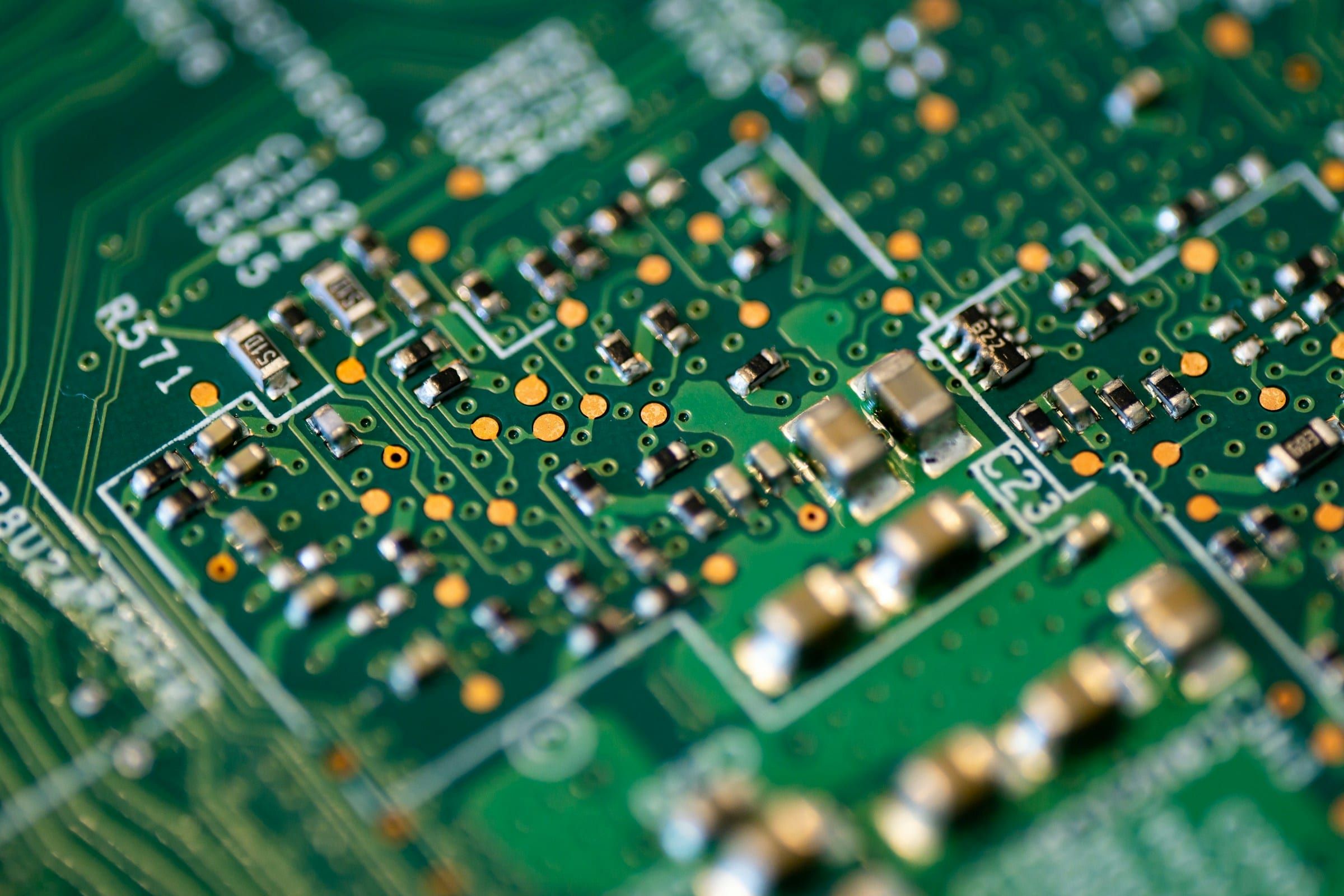
Three board spins and a failed thermal design are not waste. They are the evidence.
Iterative design and physical test is what the four-part test asks for, almost word for word. What decides a hardware claim is whether the work was U.S.-performed and who funded it - and both are answered in contracts, not in notebooks.
Photo by Magnus Engø on Unsplash
Why hardware & engineering qualifies
A new or improved device, board, mechanism, or system is a business component. The work qualifies when your team faces genuine technical uncertainty - about whether a design is even capable, which method will work, or what the appropriate design is - and resolves it through a systematic process of experimentation: modeling, prototyping, and physical testing.
Every qualifying activity must pass the IRC §41 four-part test - permitted purpose, technological in nature (engineering and the physical sciences), elimination of uncertainty, and a process of experimentation. Hardware development maps to this naturally, because iterative design and test is a process of evaluating alternatives.
Crucially, qualification is about the process, not the result. A prototype that failed, a design you abandoned, and the materials you consumed proving out an approach can all be part of a defensible claim - provided the record shows what you were uncertain about and what you tried. That record is what substantiation actually means.
Seven things that happened in your last development program
Not activity categories - situations. If any of these read like a week you actually lived, there is very likely a qualified business component underneath it.
-
“It ran 12 °C hot at the top of the ambient range.”
Three heatsink and airflow concepts were simulated, then built and instrumented on the bench. Two were discarded on the data.
Why it can qualify: The information you had did not establish a capable thermal design. Simulation plus physical test is a documented process of evaluating alternatives.
-
“The high-speed bus failed eye-diagram margin.”
Stack-up, impedance targets, and routing were revised across three board spins, with measurements between each one.
Why it can qualify: The right design was not readable off the datasheets. Each spin is an experiment against a technical requirement.
-
“The control loop missed its deadline on the target part.”
Interrupt priorities, two scheduler approaches, and a DMA path were profiled on real hardware before the timing budget closed.
Why it can qualify: Firmware developed against hardware constraints relies on computer science and engineering principles and carries genuine method uncertainty.
-
“Battery life came in at half the spec.”
Three power-management strategies were measured against an actual duty-cycle model. One had to be abandoned after the sleep-current numbers came back.
Why it can qualify: Improving performance is a permitted purpose, and the abandoned strategy is still qualified experimentation - the test is the process, not the result.
-
“The housing had to survive drop, UV, and a cost target at once.”
Candidate resins and wall sections were tested to failure until one design met all three constraints without a redesign of the internals.
Why it can qualify: Competing requirements with no known solution is the textbook elimination-of-uncertainty pattern.
-
“Pre-scan failed at 200 MHz.”
Shielding, filtering, and layout changes were iterated - each measured - until the design passed with margin.
Why it can qualify: The redesign work to reach the requirement is the qualified part. The certification run itself sits much closer to routine testing.
-
“First articles came off the line out of tolerance.”
The fixture and the process were re-engineered, with instrumented runs, before the build was released to production.
Why it can qualify: A process is a business component in its own right (§41(d)(2)(B)) - even when the product design is already frozen.
Illustrative situations, not client work. Whether any of them qualifies for you depends on your facts, your contracts, and your evidence.
The evidence is already on your bench
Hardware programs generate the cleanest §41 record of any industry, and most of it is thrown away. Board revisions, bring-up logs, thermal and EMC runs, the qualification report that failed before one passed, the bill-of-materials lines consumed proving a build - each is a dated record of an alternative evaluated.
We read those artifacts next to the agreements that funded the program, because on a hardware claim the funding terms usually decide more than the engineering does.
The engineering work that commonly qualifies
Representative activities we see meet the four-part test across hardware, electronics, and mechanical engineering.
Prototyping & design iteration
Firmware & embedded development
Electronics & PCB design
IoT systems
Materials selection & testing
Mechanical & thermal design
Test, validation & reliability
Tooling & fixtures
Environmental & compliance testing
Typical QRE categories for hardware
What spending counts toward the credit - tailored to how engineering teams actually spend.
| Expense category | What goes into the base |
|---|---|
| Engineering wages§41(b)(2)(A)-(B) | W-2 wages for engineers and technical staff performing, supervising, or directly supporting qualified development and testing. |
| Prototype supplies§41(b)(2)(C) | Materials and components consumed in building and testing prototypes - not depreciable equipment. |
| Contract engineering (65%)§41(b)(3) | 65% of amounts paid to U.S. third parties for qualified research and engineering performed on your behalf. |
| Cloud & compute§41(b)(2)(A)(iii) | Amounts paid to rent compute for simulation, modeling, and analysis used in qualified research. |
What the base usually looks like
IllustrativeA directional shape for a hardware program, not a benchmark. Supplies matter far more here than in a software claim - which is also where the sloppiest numbers tend to be.
- Engineering wages - Electrical, mechanical, firmware, and test engineering time on qualified work.
- 68%
- Prototype supplies - Boards, components, and materials consumed building and breaking prototypes.
- 20%
- U.S. contract engineering - Design houses and specialist firms, in the base at 65% of amounts paid.
- 9%
- Cloud & compute - Rented capacity for simulation and analysis.
- 3%
Where the line sits
Prototype materials and components consumed in development and testing are eligible under §41(b)(2)(C). Depreciable equipment, tooling that becomes a capital asset, and general overhead are not.
The awkward case is the prototype that survives. A unit consumed in destructive test is a supply; a unit that becomes a demo rig, a fixture, or an asset on the balance sheet has to be treated as what it became.
A credit that pays out before the product ships
§41(h) lets a qualified small business elect to apply up to $500,000 of its research credit per year against payroll taxes instead of income tax - the employer share of Social Security tax first, and the Medicare share above that. For a hardware startup that is burning engineering payroll years before revenue, that converts a credit it could not otherwise use into quarterly cash.
The definition catches people out. It turns on gross receipts under $5 million for the credit year and on not having had gross receipts before the five-year window ending in that year - so early prototype revenue or a small pilot sale years ago can close the door. The election is made on a timely-filed return, claimed on Form 8974 with your quarterly employment tax return, and cannot be made for more than five tax years.
Rough QSB screen
- Gross receipts under $5M in the credit year
- No gross receipts before the five-year window ending in that year
- A real U.S. payroll to offset
- Election made on a timely-filed return, not after the fact
- Five tax years is the maximum, ever
Summary only - the statutory definition and the aggregation rules decide it. We test them explicitly.
What a hardware study can look like
A hypothetical scenario to show how the pieces fit together. It is not a quote, projection, or promise of results.
- Engineering payroll
- $1.5M
- Share qualified
- ~65%
- Prototype materials
- $250K
- U.S. contract engineering
- $200K
- Estimated QRE
- ~$1.4M
- Illustrative federal credit
- ≈ $85K-$140K
A company on these facts would also test the §41(h) payroll-tax election - the difference between a credit carried forward and cash in the next few quarters.
Illustrative only. Figures are hypothetical and rounded; contract engineering is included at 65%, no funded-research exclusion is assumed, and the federal credit commonly works out to roughly 6-10% of QRE depending on method, filing history, and the §280C election. Your result depends entirely on your facts. This is not a quote or a guarantee.
Domestic engineering is fully deductible again
IRC §174A restores immediate, full expensing of domestic research & experimental costs - including domestic engineering and software development - for tax years beginning after December 31, 2024. Captured alongside the §41 credit, you get the deduction and the credit.
Technology & hardware - frequently asked questions
Do prototype materials count?
Does a failed prototype still qualify?
We have an SBIR grant - what can we claim?
Does testing and validation count?
Does §174A apply to our domestic engineering?
Do U.S. contract engineers count?
We’re pre-revenue - is there any cash in this?
Can we claim prior years we already filed?
We’re not a lab - do we still qualify?
Next
Qualified research expenses, category by category
Where prototype materials stop being supplies and start being depreciable property, and how contract research enters at 65%.
Also relevant
If you also make the thing you designed, the process itself is a separate business component - and usually the larger one.