
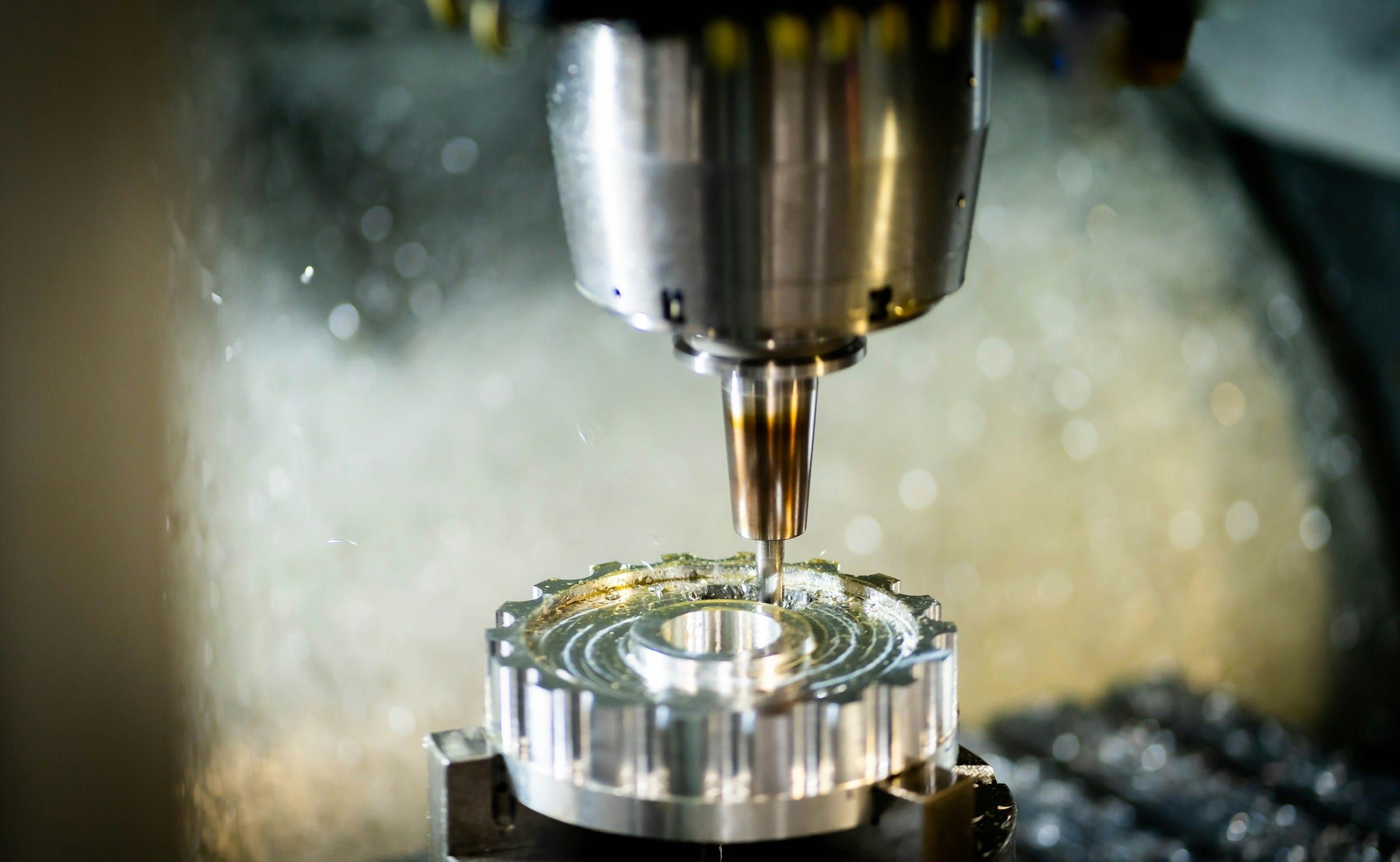
The statute says “process.” Most manufacturers only ever claim the product.
Re-engineering how you make a part - to raise yield, cut scrap, hold a tighter tolerance, or shorten a cycle - is a business component in its own right under §41(d)(2)(B), even when the part you sell never changes. That one word is where most of the missed credit lives.
Photo by Jelifer Maniago on Unsplash
Why manufacturing qualifies - products and processes
Under §41, a business component is a product or a process. That second word is where manufacturers most often leave money behind: re-engineering how you make a part to raise yield, cut scrap, increase throughput, or hold a tighter tolerance is qualified research when it resolves genuine technical uncertainty through a systematic process of experimentation - even when the product you sell never changes.
Every qualifying activity must pass the IRC §41 four-part test - permitted purpose, technological in nature (engineering and the physical sciences), elimination of uncertainty, and a process of experimentation. Trial runs, tooling development, automation integration, and first-article qualification all tend to map cleanly to this.
The reason it’s missed is cultural: this work looks like “just doing our jobs on the floor,” the time isn’t tracked to the four-part test, and generalist preparers rarely ask about process development. Mapping each activity to the statute - with contemporaneous evidence from travelers, run sheets, and engineering change orders - is what turns it into a defensible claim.
Seven things that happened on your floor last year
Not activity categories - situations. If any of these read like a job you actually ran, there is very likely a qualified business component underneath it.
-
“The new alloy scrapped one part in six.”
Feeds, speeds, tool geometry, and coolant strategy were varied across instrumented trial runs until the scrap rate came down and stayed down.
Why it can qualify: Improving a process is a permitted purpose, the trials are the experimentation, and the material consumed proving it out is a supply QRE.
-
“Nobody could hold half a thou on that geometry.”
Two fixturing concepts and a thermal-compensation approach were proven out on the machine, one at a time, with measured results.
Why it can qualify: Capability uncertainty about your own process, resolved by testing alternatives - not solved by buying a better machine.
-
“The robot cell could not pick the part reliably.”
Gripper designs, vision lighting, and sequencing were tested against real part-to-part variation until first-pick rate held at production speed.
Why it can qualify: Integration qualifies when the configuration has to be engineered and proven. Installing standard equipment as specified does not.
-
“The bottleneck operation set the whole plant’s cycle time.”
The operation was redesigned and run instrumented; two of four candidate sequences were discarded on the numbers.
Why it can qualify: Throughput improvement to a process business component - one of the most valuable and least-claimed activities in manufacturing.
-
“The progressive die would not hold the form.”
Trial shots, springback compensation, and successive die revisions until the part came off within print at rate.
Why it can qualify: Tooling developed to enable a new part is process development, and the material consumed in trial shots is consumed in research.
-
“The customer wanted the same part in a different material.”
Coating and heat-treat candidates were trialed and destructively tested against a durability specification that nobody could predict on paper.
Why it can qualify: Careful here: adapting an existing component to one customer’s requirement is excluded by §41(d)(4)(B). What can qualify is genuine development where the outcome was not knowable in advance.
-
“PPAP failed on capability, not on paperwork.”
The process was re-engineered and re-qualified with new runs before the submission went back out.
Why it can qualify: The submission package is not research. The process development that moved the capability numbers can be.
Illustrative situations, not client work. Whether any of them qualifies for you depends on your facts, your purchase orders, and your evidence.

The record a process claim is built from
Process development leaves paper: first-article reports, tooling trials, run cards with scrap counts, capability studies that failed before one passed. That paper is what turns "we improved the line" into a business component someone else can follow.
We read it next to the purchase orders, because who paid for the development - and who owns the tooling and the design at the end - decides more manufacturing claims than the engineering does.
The manufacturing work that commonly qualifies
Representative product and process activities we see meet the four-part test on the shop floor and in engineering.
New & improved products
Process engineering & development
Automation & robotics integration
Tooling, dies & fixtures
Scrap, yield & throughput
New materials & treatments
CNC programming for new parts
First-article & pilot runs
Quality-driven process changes
Typical QRE categories for manufacturers
What spending counts toward the credit - tailored to how manufacturers actually spend.
| Expense category | What goes into the base |
|---|---|
| Technical wages§41(b)(2)(A)-(B) | Wages for engineers, technicians, and shop-floor engineers or supervisors directing qualified product and process development. |
| Trial & scrap supplies§41(b)(2)(C) | Materials consumed in development trials and scrap generated during experimentation - not routine production scrap. |
| Contract engineering (65%)§41(b)(3) | 65% of amounts paid to U.S. third parties for qualified engineering or development performed on your behalf. |
| Cloud & compute§41(b)(2)(A)(iii) | Amounts paid to rent compute for simulation or modeling used in qualified product or process research. |
What the base usually looks like
IllustrativeA directional shape for a manufacturer, not a benchmark. Trial material is the category most likely to be either forgotten entirely or claimed far too broadly.
- Technical wages - Engineers, technicians, and the shop-floor supervision directing development work.
- 70%
- Trial & scrap supplies - Material consumed in development trials, pilot runs, and first articles.
- 21%
- U.S. contract engineering - Outside toolmakers and integrators, in the base at 65% of amounts paid.
- 7%
- Cloud & compute - Rented capacity for simulation, tolerance analysis, and modeling.
- 2%
Where the line sits
Development trials, pilot runs, and the scrap they generate can qualify. Routine production, ongoing quality control, and scrap from a process already in commercial production do not.
The practical test an examiner will apply is whether the run can be identified - a work order, a traveler, an engineering change order, a trial number. An annual scrap account with one figure in it is not an allocation; it is an assertion.
The federal credit is rarely the whole number
Manufacturing is capital- and location-intensive, which is exactly the profile states legislate for. Most states with a corporate income or franchise tax run their own R&D credit, each with a different base, rate, cap, carryforward, and refundability - and a federal number multiplied by a state rate is not a state credit. Ricerca computes both from one substantiated research base.
If you are a newer shop, test §41(h) too: a qualified small business may elect to apply up to $500,000 of credit per year against payroll taxes rather than income tax. It turns on gross receipts under $5 million in the credit year and on not having had gross receipts before the five-year window ending in that year, it is claimed on Form 8974 with your quarterly employment tax return, and it cannot be elected for more than five tax years.
What a study should hand you
- A federal §41 credit with per-business-component support
- Every applicable state credit off the same base
- The §280C election modeled, not assumed
- A §174A treatment for domestic R&E
- Workpapers and narratives your preparer can file from
See how a study runs.
What a manufacturing study can look like
A hypothetical scenario to show how the pieces fit together. It is not a quote, projection, or promise of results.
- Technical wages
- $900K
- Share qualified
- ~45%
- Trial & scrap materials
- $150K
- Estimated QRE
- ~$555K
- Illustrative federal credit
- ≈ $33K-$55K
Before any state credit, and before the §174A deduction on the same domestic spend.
Illustrative only. Figures are hypothetical and rounded; no funded-research exclusion is assumed, and the federal credit commonly works out to roughly 6-10% of QRE depending on method, filing history, and the §280C election. Your result depends entirely on your facts. This is not a quote or a guarantee.
Domestic development is fully deductible again
IRC §174A restores immediate, full expensing of domestic research & experimental costs for tax years beginning after December 31, 2024 - including qualified product and process development performed in the U.S. Captured alongside the §41 credit, you get the deduction and the credit.
Manufacturing - frequently asked questions
We already sell the product - does improving how we make it count?
Our customer pays for the tooling development - can we still claim it?
Does scrap from development trials count?
Does automation and robotics work qualify?
Does shop-floor engineering time count?
Does §174A apply to our domestic development?
We’re a small shop - is it worth it?
Can we claim prior years we already filed?
How much does the calculation method change the number?
Next
The four-part test, applied to a process
How a production process is treated as its own business component, and where the shrink-back rule lands when only one step was uncertain.
Also relevant
If your engineering group designs the product as well as the line, the hardware page covers the prototype and test side.