R&D tax credits and cost segregation

Tax incentives for what you build and own

Substantiated before anything is claimed.

Our R&D experts finalize your R&D credit study; your cost segregation study is reviewed and approved by a CPA. Every figure traces to your own records.

We typically reply within one business day.

Or size it yourself: the R&D credit calculator or the cost segregation calculator.

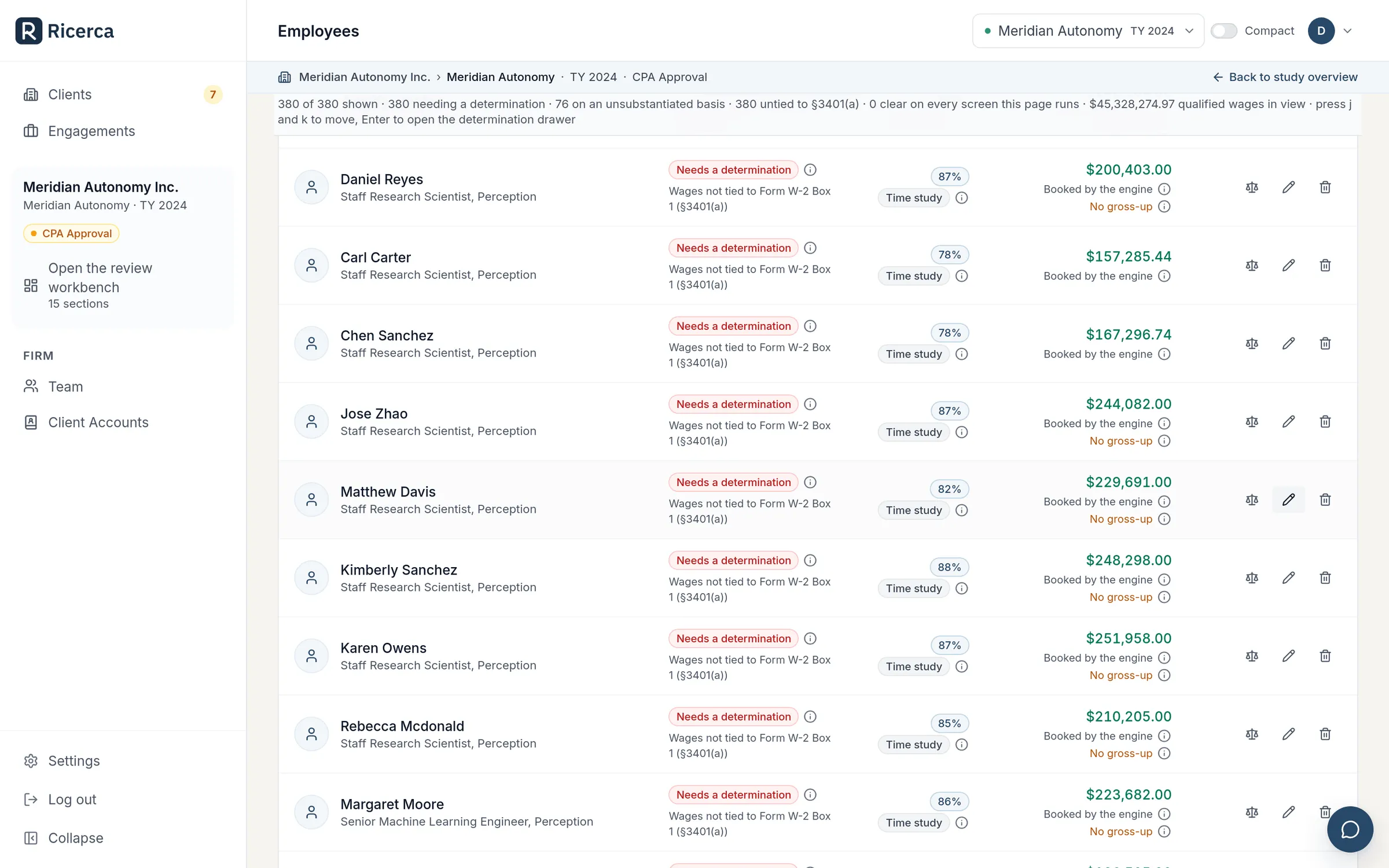
Detail of the study review workbench: the federal credit, state credits and credit base figures of a synthetic study.
  1. Callout 1: Federal and state credit figures, computed from one substantiated base

The study review workbench, as our reviewers see it. Synthetic study data, not a real client and not a filed return.

Start with what you have

I build products, processes or software

See what the R&D tax credit and the §174A deduction could be worth to your company.

I own or am buying a building

See how a cost segregation study could bring depreciation on the property forward.

What we do

Two studies, one team

One client portal serves both, and each is quoted in writing before any work begins.

All services
R&D tax credit

R&D credit study

The federal §41 credit and your state credits, substantiated business component by business component, with the §174A deduction and the §41(h) payroll offset where they apply.

Who it’s for
Companies whose engineers solve technical problems: software, hardware, manufacturing, life sciences, engineering.
What you get
A study report, a filing packet for your preparer, and pro-forma Forms 6765, 8974 and 3800.
How it’s priced
A written quote before any work begins, fixed at engagement-letter signature.
Cost segregation

Cost segregation study

Parts of your building reclassified into 5-, 7- and 15-year property, so more depreciation lands in the first years.

Who it’s for
Owners of commercial and residential rental property, bought, built or renovated.
What you get
A study report reviewed and approved by a CPA; your preparer can request the asset schedule and Form 3115 support.
How it’s priced
A fixed fee, never a percentage of the deduction.

Not sure which applies, or think it might be both? Manufacturers, engineering and architecture firms, labs and medical device makers often own the building the research happens in. The free assessment sorts it out.

In the statute

Four figures set by law, not by us

a year of the credit a qualified small business may apply against employer payroll taxesIRC §41(h)(4)(B), claimed on Form 8974
$500,000
of qualified research expenses above half the prior three-year average, under the Alternative Simplified CreditIRC §41(c)(4)(A)
14%
of what you pay a contractor for qualified research counts as a qualified research expenseIRC §41(b)(3)(A)
65%
that an unused R&D credit carries forward, as part of the general business creditIRC §39(a)(1)
20 years

Statutory figures, not a forecast of your credit. Eligibility and limits depend on your facts.

Deliverables

What a study hands you

The study package, issued together and reconciling with itself. The file behind it stays with your Ricerca team.

See a sample study
  • Study report: A technical narrative for each business component.
  • Filing packet: Every figure your preparer enters, keyed to its form line.
  • Form 6765: Sections A to G, with the Section G component detail.
  • Form 8974: Included when the §41(h) payroll offset is elected.
  • Pro-forma Form 3800: Where the credit lands in the general business credit.
  • Controlled-group statement: Where related entities are one taxpayer under §41(f).
Illustrative view of a study package. What a given engagement includes depends on the elections made and the forms its return actually needs.

The QRE workpapers and the audit-defense binder stay with your Ricerca team as the file behind the study, which is what Audit Protection draws on if the claim is examined.

Cost segregation study

What a cost segregation study hands you

You receive the study report. Your CPA or tax preparer can request the asset schedule and depreciation workbook, and Form 3115 support where a look-back applies.

How a cost segregation study works
Issued to you Study report
Methodology, schedules by recovery period and reconciliation to cost, reviewed and approved by a CPA.
On request, for your preparer Asset schedule
Every component with its class, method, convention and placed-in-service date.
Where a look-back applies Form 3115 support
The §481(a) computation your preparer needs to file the accounting method change.
Kept with the study Workpaper binder
Organized around the information requests an examiner issues.
Why Ricerca

Two ways this usually goes wrong

The test of a study is whether it can say this product, this process, this software, this year, and show where every number came from. Two familiar approaches struggle with that for opposite reasons.

Traditional consultants

  • A questionnaire, a kickoff call, and months of quiet.
  • A study you never see the inside of until it is finished.
  • Qualified percentages assigned by someone who never spoke to the engineer.

Automation-only software

  • A questionnaire, a classifier, and a PDF.
  • Fine right up to the moment someone asks which alternatives your engineers actually evaluated.
  • Nobody puts their name on the answer.

Ricerca

The §41 tests are enforced in software before a dollar is counted, and experienced R&D experts review and finalize every R&D credit study before it is issued.

Experts finalize every R&D credit study
Experienced R&D experts review and finalize every R&D credit study before it is issued.
Built to defend on exam
Substantiation mapped to the four-part test and to each business component, with contemporaneous evidence: the documentation examiners actually ask for.
Credit and §174A, captured together
We capture the new §174A domestic expensing too, so you get the deduction and the credit, correctly.

Know exactly what you’re claiming, before you claim it

Plain-English deep dives into the statute our engine enforces. New to all of this? Start with the complete R&D tax credit guide.

Photo by EnCata PD on Unsplash

Inside the platform

One engine for federal, state, payroll offset and §174A

It enforces the §41 tests before counting a dollar, computes every benefit from one substantiated base, and challenges its own work before experts finalize.

Inside the platform
  1. Wages allocated person by person

    Every person in the claim carries a qualified percentage and the basis recorded for it, so the wage line is a sum of decisions, not an estimate applied to a department.

    • Regular Credit and ASC computed side by side, with the §280C(c) election modeled
    • §41(f) controlled groups aggregated as one taxpayer and allocated across members
    How the credit is computed
    Rows of a wage allocation grid: each employee with a qualified percentage, the basis recorded for it, and the qualified wage figure.
    Synthetic study data.
  2. Nothing issues until the checks clear

    Three steps in a fixed order: the final document is generated, the study is locked, then it is issued to you. Nothing runs while a pre-issuance check is open.

    • An independent AI examiner red-teams the study, and a second model family checks the statutory tests and the math
    • Form 6765 (Dec. 2024 revision, Sections A-G), Form 8974 and a pro-forma Form 3800 that reconcile on their face
    • State R&D credits computed from the same substantiated base
    See a sample study
    The three delivery steps on a finalized study: generate as final, finalize and lock, issue to the client, each marked done.
    Synthetic study data.

Connect payroll, GL and engineering systems or upload exports. How your data gets into the study.

2025 changed the math

Domestic R&D is fully deductible again

The One Big Beautiful Bill Act created IRC §174A, restoring immediate, full expensing of domestic research costs for tax years beginning after December 31, 2024, software development included. Balances capitalized in 2022-2024 can come back, by election, as a catch-up deduction in the first tax year beginning after December 31, 2024 (or spread over two years).

  • Immediate deduction for domestic R&E, no more 5-year amortization
  • Software development costs explicitly included
  • Catch-up deduction for balances capitalized in 2022-2024, in the first tax year beginning after December 31, 2024, or spread across two years

The deduction and the credit interact: §174A changes what you deduct, and the §280C(c) election changes what the credit is worth net of it. We model both together, not one at a time.

Illustrative. First-year federal deduction on $1,000,000 of domestic R&E paid or incurred in 2025 - about $100,000 under prior 5-year amortization vs. the full $1,000,000 under §174A. Actual results depend on your facts; this is not a projection of your benefit.
View data
First-year deduction on $1,000,000 domestic R&E (illustrative)
Treatment First-year deduction
Prior TCJA §174 (5-yr amortization)$100,000
New §174A (immediate)$1,000,000

Inside the engine

One substantiated base, four benefits out

Inside the platform
Diagram: intake, statutory tests, computation, and expert final call, producing the federal §41 credit, state R&D credits, the §174A deduction, and the payroll tax offset INTAKE STATUTORY TESTS COMPUTATION EXPERT FINAL CALL Federal §41 credit State R&D credits §174A deduction Payroll tax offset

How we use AI, and what stays human

AI accelerates intake, document parsing, activity identification, narrative drafting, and QRE computation. Qualification, amounts, and the final call are decided by people: our R&D experts review and finalize every R&D credit study before it’s issued. See the process.

Serious about your data

Encryption in transit and at rest, least-privilege access, data minimization, and a clear retention policy. Your confidential data is never used to train public or third-party AI models. Our security approach.

Audit Protection included

We stand behind your R&D claim

Every Ricerca R&D credit study includes Audit Protection. If the IRS examines the R&D tax credit claim from your study, we prepare the response, provide the examiner with the documentation they request, and defend the study’s technical position alongside your tax preparer - under the terms of your engagement agreement.

Representation before the IRS, where it is needed, is performed by credentialed practitioners.

Focused on your R&D claim

Audit Protection covers the R&D study and the related federal R&D tax credits only - not other parts of your return, other tax years, other credits or deductions, payroll taxes, state or local taxes, penalties, or interest.

Based on accurate information

Protection applies as long as the information you give us for the study is accurate and complete. If it isn’t, Audit Protection does not apply and we will not prepare or defend a response to the resulting issue.

How a study runs

A rigorous study, without the drag

Six phases, and at every one you know what we need from you and what you get back.

See the full process
  1. Scope and connect. What we need from you: Entity, tax years, and who owns the technical work. What you get: A scoped engagement and a connection plan.
  2. Intake and data pull. What we need from you: Access to payroll, the ledger and ticketing. What you get: Your own data pulled, reconciled and mapped.
  3. Identify and interview. What we need from you: Short interviews with each technical lead. What you get: A business component list with named owners.
  4. Narratives and QRE computation. What we need from you: Confirmation of the component list. What you get: Draft narratives and the QRE figures to confirm.
  5. Adversarial AI review and expert finalization. What we need from you: Answers to the questions the review raises. What you get: A finalized position signed off by our R&D experts.
  6. Deliver and file support. What we need from you: Your preparer and their filing dates. What you get: The study report, filing packet and Form 6765 package.
  7. Pace is set by how fast your data lands, not by a calendar we hand you.
Illustrative. These are the phases every R&D credit study runs through. No fixed duration is implied and the elapsed time is not a promise.

Cost segregation runs on its own eight steps, from the property profile to the approved report. How a cost segregation study works.

Built on the standards examiners look for

Every R&D credit study is structured around the authorities the IRS actually applies, not marketing claims. The documentation guide walks through what an examiner requests and why.

IRC §41(d) four-part test
Applied to every activity, in every business component.
Treas. Reg. §1.41-4 + §6001
What qualifies as research, and the records you must keep to prove it.
Form 6765 (Dec. 2024 revision)
Including the new Section G business-component detail.
Free assessment

See what your work and your buildings qualify for

Tell us about your R&D or your property. We come back with what a study could capture and a written quote, free and with no obligation.

[email protected] We typically reply within one business day.
Get your free assessment

We typically reply within one business day.